Vacation Rental Cancellation: What You Get Back and When

A vacation rental cancellation comes down to three things: the refund schedule in your booking terms, which fees are refundable, and what happens if the host cancels on you. Read those before you pay. With a big group, a late cancellation costs more, because one house holds everyone’s money. Book through a property’s own official booking page, and the terms for that exact home are in front of you before you commit. That is how we think group travelers should plan, whether the trip is a Scottsdale reunion or a Flathead Lake wedding weekend.
TL;DR
-
Cancellation terms are set per booking. Find the deadline for a full refund, the deadline for a partial one, and the date after which you get nothing.
-
Nightly rent and taxes are the parts most often refunded. Service, booking and processing fees often are not, so look at each line item.
-
If a host or manager cancels, you should expect a full refund or a comparable home. Document everything and pay by credit card.
-
Travel insurance covers different problems than a booking guarantee. For a large group trip, it is worth reading both.
-
Verify every detail on the official booking page before you pay and again before you travel.
Table of Contents
How cancellation policies set your refund
Every vacation rental booking carries a cancellation policy. It is a schedule. It says how many days before check-in you can cancel, and what share of your money comes back at each stage.
Most schedules have three zones:
-
Early window. You get most or all of your payment back, sometimes minus a fee.
-
Middle window. You get part of the rent back, often half.
-
Late window. Nothing comes back, or only items like a security deposit.
The exact day counts differ from home to home and platform to platform. We are not going to give you one “standard” number, because there isn’t one. Your booking confirmation and the official booking page are the only places that tell you what applies to your stay.
The schedule also usually counts from check-in time, not from the date on the calendar. If you are cancelling near a deadline, check what time zone and cutoff the terms use. A home in Montana and a home in Arizona are not always on the same clock, and Arizona does not shift its clocks for daylight saving time, so the gap with Montana changes during the year.
Why big groups feel it more
A hotel room cancellation affects one room. A large-group house affects up to 18 people at once. One person drops out, and the house still costs the same. If you are splitting the bill, a late cancellation becomes an awkward money conversation fast. Our guide on splitting vacation rental costs covers how groups can agree on who owes what before anyone pays.
A simple habit helps. Before you collect deposits from your group, tell everyone the refund deadlines. Then cancel-or-commit decisions happen early, while the money is still recoverable.
Which fees come back and which usually don’t
A rental total is rarely one number. It is a stack: nightly rent, taxes, a cleaning fee, sometimes a service or booking fee, and sometimes a security deposit or optional protection plan. Each line can have its own refund rule.
Here is a general guide to how these lines are commonly handled. Your own terms win over this table.
| Charge | What it is | Often refundable on cancellation? |
|---|---|---|
| Nightly rent | The base price for your dates | Yes, by the schedule |
| Taxes | Lodging taxes on the rent | Usually follow the rent |
| Cleaning fee | One-time fee for turnover | Depends on the terms |
| Service or booking fee | Charged by a platform or manager | Often not |
| Security deposit | Held for damage | Returned if you cancel and no stay occurs |
| Optional insurance | Add-on protection | Read the plan terms |
One aggregator survey from October 2026 puts cleaning fees at roughly $50 to $150 and platform service fees in the low-to-mid teens by percentage. Treat that as a ballpark. For a house that sleeps up to 18 people, the cleaning fee can run well above it, so check the real figure on the page you book from.
Read the total price before you click pay
Fee transparency is improving. California has required advertised prices to include mandatory fees since July 1, 2024, according to a summary of US junk-fee rules that also notes similar rules in other states. If a price looks low and then jumps at checkout, compare the final total, not the headline rate.
Before you pay, find these on the checkout page:
-
The full total with every fee included
-
The cancellation deadlines, written as dates
-
Whether the cleaning fee comes back if you cancel early
-
The security deposit amount and when it is released
Screenshot the page. It gives your group a shared reference if anyone asks later what was agreed.
What to check in the terms before you book
This is the part that saves you. Spend ten minutes here and you will rarely be surprised.
1. The refund dates. Write them on your calendar. Work out the date for a full refund, the date for a partial one and the final cutoff.
2. What “cancel” means for changes. Moving your dates is not always the same as cancelling. Ask whether a date change keeps your original terms, or starts a new policy.
3. Who holds the money. Some bookings charge everything upfront. Others split it into a deposit and a balance due later. Know when the balance is due, because the cancellation schedule often lines up with it.
4. Guest count and house rules. Large houses have occupancy limits, quiet hours and rules about events. If your plans change and you need to add people, you want to know whether that is allowed. Clear house rules are part of what makes a group stay run smoothly.
5. What happens if the home can’t be used. Look for language on power outages, wildfire smoke or road closures, or damage before arrival. Terms differ, and this is where they get specific.
6. Payment method. Pay by credit card if you can. Consumer Reports’ Checkbook advises paying by credit card and reading the cancellation rules before you book. A card gives you a way to dispute a charge if something goes wrong.
If you are comparing a direct booking against a big platform, our guide to booking direct versus using a platform walks through the official booking calendar and what to look at on each side.
Planning around the seasons
Cancellation risk is not the same all year. The calendar matters, and it is different in each of our two destinations.
Scottsdale and the Phoenix area
Winter and early spring are the busy stretch in the Valley of the Sun. Mild weather draws groups for reunions, golf trips and long winter stays. Summer is hot. Dates around big events, spring training and holiday weeks tend to book early, so you will often face firmer deadlines on those dates. Our Scottsdale group stays page shows what the homes offer, and our golf trip planner helps you map a trip for a group.
Flathead Valley and Glacier
In Montana, summer is peak season. Lake days, cherries, the Fourth of July and trips to Glacier National Park fill the calendar. Our Flathead Lake summer guide covers the rhythm of those weeks. Weather in the mountains can shift plans, so check conditions and any park or road updates before you travel, and verify details with the official sources. Wedding weekends in Whitefish, Bigfork and around the lake also book up. If you are lining up guest lodging, see our Montana wedding guest lodging guide.
The takeaway for both places: the busier the dates, the earlier you should settle your group’s commitment and the more closely you should read the refund schedule.
If the host or manager cancels
This one is not your fault, and you should not lose money over it. It still takes some work.
Checkbook’s review of the industry found that one large platform’s terms guarantee full refunds if the host cancels before check-in, fails to provide access, or the place is not habitable at check-in. Other platforms and managers set their own terms, so the details depend on where you booked.
What to do:
-
Get it in writing. Ask for the cancellation notice by email or in the booking message thread.
-
Ask for a refund or a comparable home. Be specific about your dates and group size. Finding another house for 14 people on short notice is hard, so act fast.
-
Keep records. Save messages, receipts and screenshots of the listing.
-
Use your card if needed. A guide to renters’ rights notes that the Fair Credit Billing Act lets you dispute charges with your card issuer, generally within 60 days of the statement date, with documentation of what you tried with the merchant first.
A few states also have their own rules. North Carolina’s attorney general, for example, explains that the state’s Vacation Rental Act requires refunds for nights a guest can’t stay after a mandatory evacuation in certain cases. California has a rule on a free cancellation window, covered next. Your own state may have something similar, so look at your state attorney general’s consumer page.
The California 24-hour rule
If you book a California stay, one rule is useful to know. California Civil Code section 1748.81, from SB 644 and in effect since January 1, 2024, requires that qualifying reservations made at least 72 hours before check-in can be cancelled without penalty for at least 24 hours after confirmation. The refund must include all amounts paid and go back to the original payment method within 30 days.
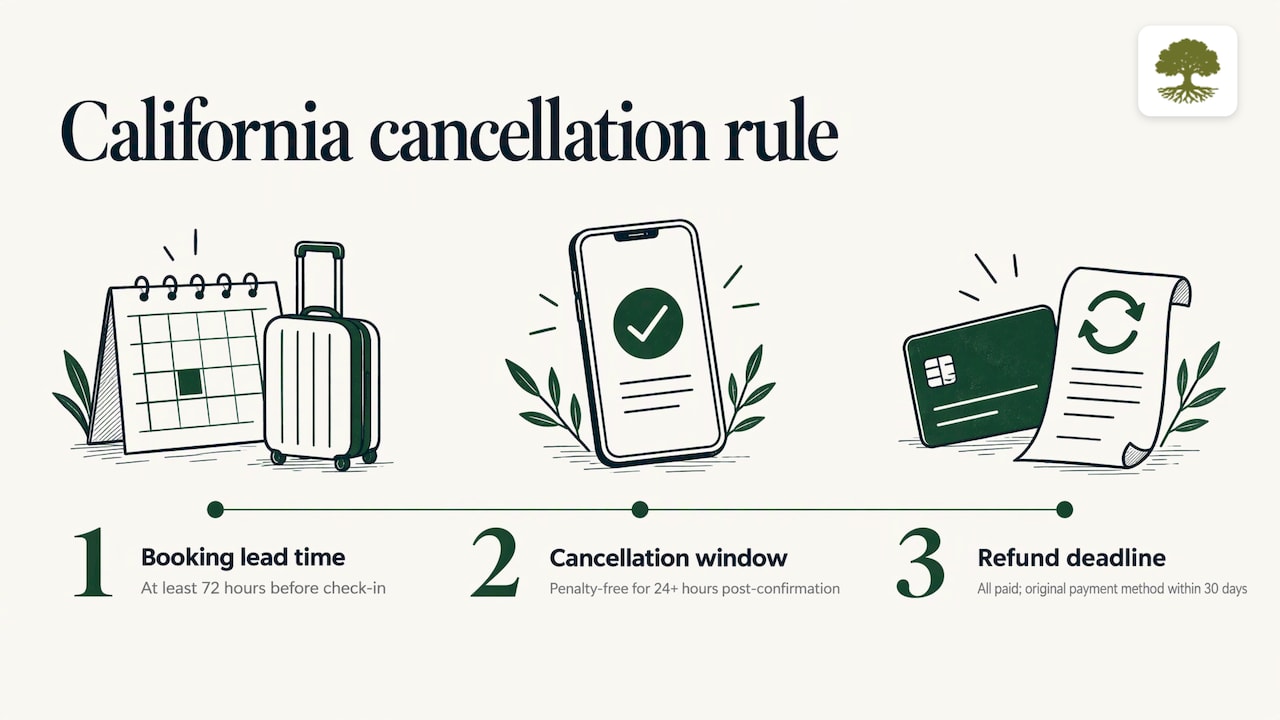
The same text excludes some bookings, such as negotiated rates not offered to the public. This is a California rule. It does not mean every state works this way, and our homes are in Arizona and Montana, so look at the booking terms for your actual reservation.
Cancellation insurance and travel insurance
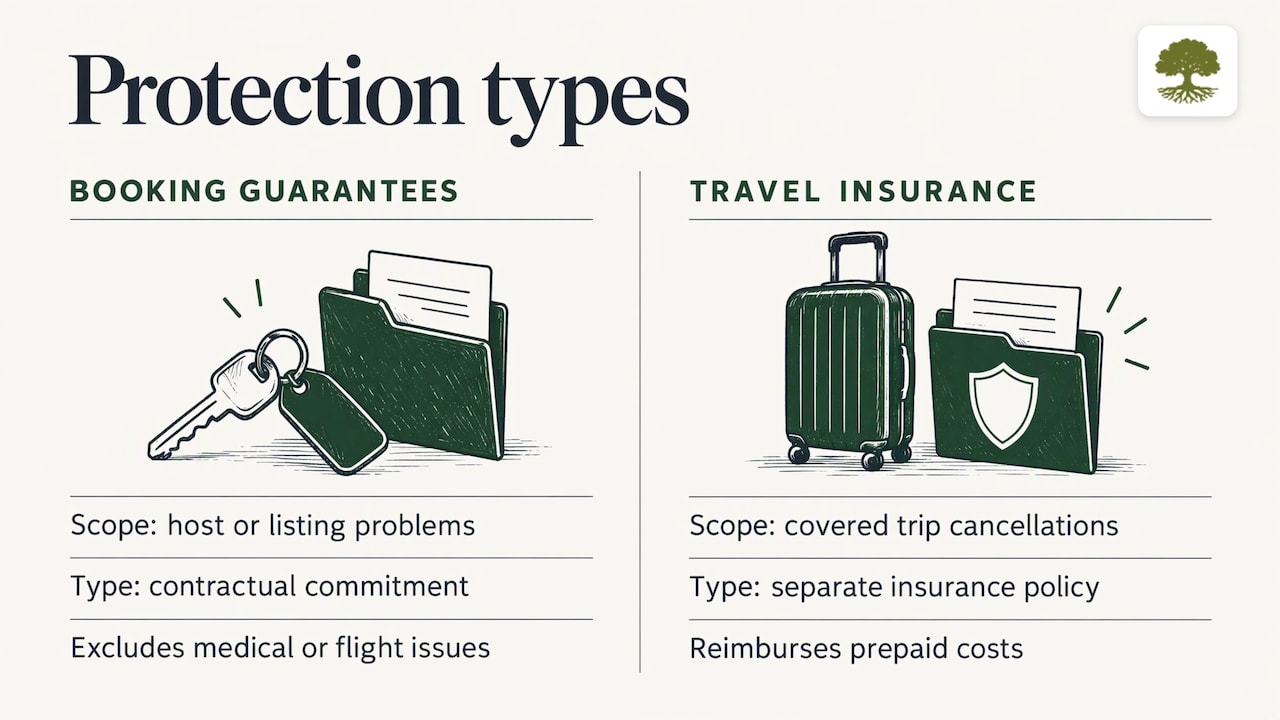
People mix up two different protections.
Booking guarantees are promises from a platform or manager about the rental itself. They cover problems like a host cancelling or a listing not matching its description. One legal guide points out that these are contractual commitments, not travel insurance, and they do not cover things like a medical emergency or a cancelled flight.
Travel insurance is a separate policy. Depending on the plan, it can reimburse prepaid costs when a covered reason forces you to cancel. Covered reasons vary by policy, so read the list of what counts. For a general explainer on how trip insurance works, this travel insurance comparison guide is a good place to see the options laid out.
For group trips, the question gets bigger. Who buys the policy? Does it cover one traveler or the whole group? Our guide to group travel insurance for large vacation rental trips goes through those choices. Buy insurance soon after your first payment, since some plans have time limits for certain benefits. Check the policy for the exact rules.
A cancellation checklist for group organizers
Use this before you pay and again before you collect money from friends or family.
-
Save the cancellation policy as a PDF or screenshot.
-
Put every deadline on a shared calendar.
-
Tell the group which deadline is the last safe one.
-
Collect payments after everyone knows the terms.
-
Decide in advance what happens to a share if someone drops out. Can they find a replacement? Does the group absorb it?
-
Check the guest limit so a replacement does not put you over.
-
Look at your payment method and any insurance.
-
Verify details again before travel, including check-in times and house rules.
This also works for the nonstandard trips. A month-long winter stay has a different rhythm from a long weekend. If that is your plan, see how to plan a 30-day stay, and for Scottsdale winters, our snowbird and long stay guide.
Our perspective
We built Trailstead Stays around group trips, and group trips are where cancellation questions get serious. Up to 18 people share one reservation. One change ripples through everyone’s plans and everyone’s wallet.
That is why we send guests to each home’s official booking page. You see the home, the dates and the terms in one place, tied to that exact house. There is no guessing about which version of the rules applies.
We also like the two-home approach. Guests can compare homes and reserve two in one destination, so a big group can stay close together without squeezing into one house. In Scottsdale, that means warm winters and desert scenery. In the Flathead Valley, it means lake days and easy access to Glacier country. Whichever you pick, read the terms, note the dates and share them with your group before money moves.
Our advice is simple. Plan early, write down the deadlines and verify every detail before you travel.
Trailstead Stays Team
Ready to compare homes?
Trailstead Stays has four homes for large groups: The Sunkiss Scottsdale and The Scottsdale Social in Arizona, and The Evergreen at Flathead Lake and The Tamarack in Montana. They have detailed sleeping layouts for multigenerational groups, reunions, weddings and corporate retreats. You can see all four on our large group vacation rentals page, then go to the official booking page for the home you like.

For Montana, start with our Flathead Lake vacation rentals for groups. For general group trip ideas, see group stays for weddings, reunions and friends.
FAQ
What is a typical vacation rental cancellation policy?
There is no single typical policy. Most use a schedule: a full or mostly full refund if you cancel early, a partial refund in the middle, and little or nothing close to check-in. The day counts differ by property and platform, so read the terms on your booking page.
Are booking fees refundable?
Often they are not. Nightly rent and taxes tend to follow the refund schedule, while service, booking or processing fees may be kept. Look at each line of your total before you pay, and ask for the fee rules in writing if they are unclear.
What should I do if the host cancels my reservation?
Get the cancellation in writing, ask for a full refund or a comparable home, and save all messages and receipts. If you paid by credit card and the issue is not resolved, you can ask your card issuer about a dispute. Filing within 60 days of the statement date is the usual window under the Fair Credit Billing Act.
Does travel insurance cover a vacation rental cancellation?
It can, but only for the reasons listed in the policy. Booking guarantees from platforms cover host and listing problems, which is a different thing. Read the policy’s list of covered reasons and its deadlines, and think about who in your group needs coverage.
Can I change my dates instead of cancelling?
Sometimes. Whether a date change keeps your original terms depends on the booking. Check the page where you booked, and confirm any change in writing so the new dates and deadlines are clear.